
St. Louis County Death Records
St. Louis County death records are held by the county auditor-treasurer in Duluth and by the Minnesota Department of Health in St. Paul. As the largest county in Minnesota by area, St. Louis County covers a wide stretch of northeastern Minnesota, including Duluth, Virginia, Hibbing, and dozens of smaller communities whose death records all flow through county and state offices.
St. Louis County Overview
St. Louis County Vital Records Office
St. Louis County vital records are handled through the Auditor-Treasurer's Office. The county seat is Duluth, which is also where the main county government offices are located. The county's vital records department can be found through the St. Louis County website at stlouiscountymn.gov. The vital records page is at stlouiscountymn.gov/departments/auditor-treasurer/vital-records/. Call ahead or check the site before visiting to confirm current hours and procedures.
St. Louis County is the largest county in Minnesota by land area, covering more than 6,000 square miles. Because of its size, the county handles a high volume of vital records. The auditor-treasurer's office holds death records from 1997 forward for all deaths registered anywhere in Minnesota. For deaths that happened within St. Louis County before 1997, older records going back to 1908 may also be on file. The Minnesota Department of Health maintains the full statewide registry from 1908 to the present at health.state.mn.us/people/vitalrecords/death.html.
Duluth, the county seat, is the largest city in northeastern Minnesota and serves as the regional hub for government services, including vital records. The Duluth City Clerk's Office may also have some city-level records; their site is at duluthmn.gov/city-clerk/.
The Minnesota Department of Health maintains the main portal for ordering certified death certificates statewide. The screenshot below is from the MDH vital records page, which covers deaths across the entire state including St. Louis County.
Visit the MDH death records page to review ordering options and eligibility requirements for St. Louis County deaths.
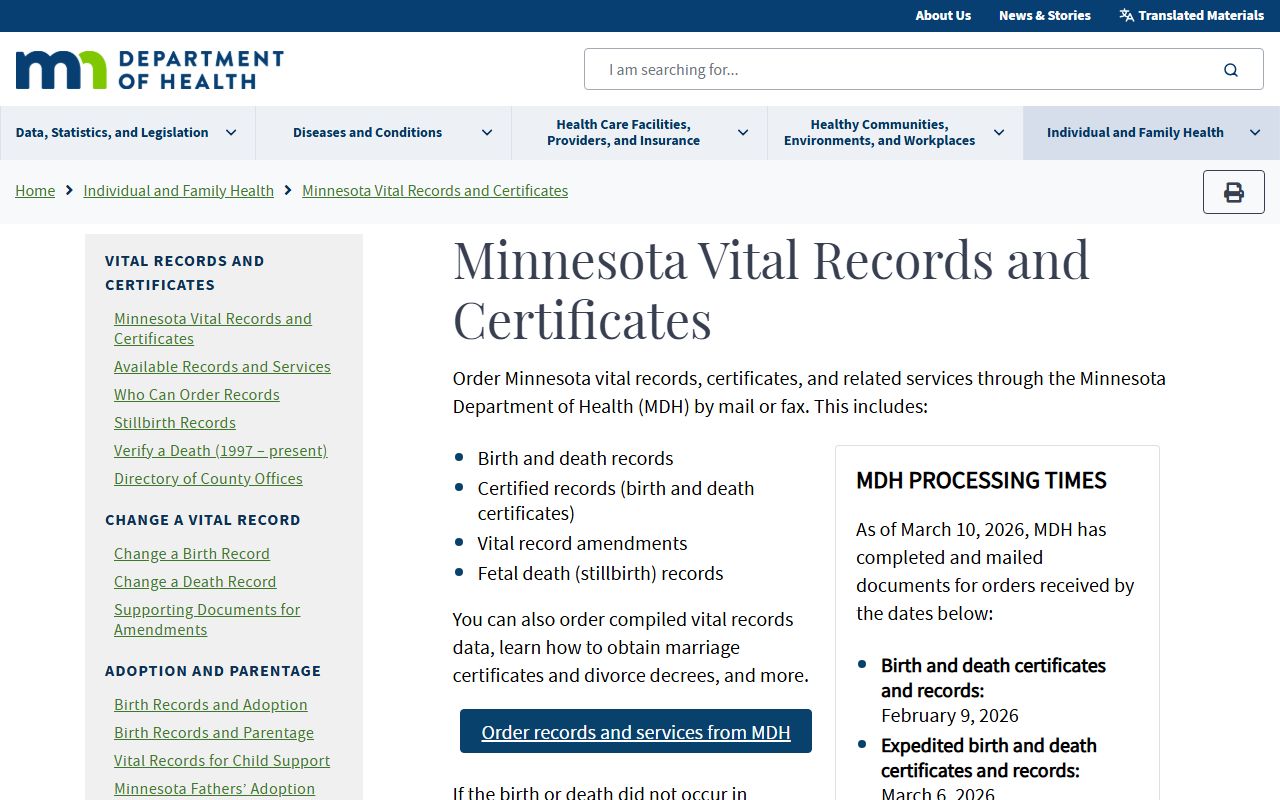
The MDH page lists all methods for ordering a death certificate, including mail, in-person at the St. Paul office, and online through VitalChek.
For local historical records related to the Duluth area and broader St. Louis County, the St. Louis County Historical Society maintains archives at thehistorypeople.org. Their collection includes older death records and related materials not held by the state.
Getting a Death Certificate in St. Louis County
You can request a death certificate for a St. Louis County death in three ways: in person, by mail, or online.
Visiting the St. Louis County Auditor-Treasurer's Office in Duluth in person is the fastest method. Bring a valid photo ID, the full name of the person who died, the date of death, and payment. If you need a certified copy, you must fall within the eligible categories under Minnesota Statute 144.225. Eligible people include the spouse, parent, child, sibling, grandparent, grandchild, legal guardian, or authorized representative of the deceased. Others can request a noncertified copy or must show a documented legal need.
Mail requests go to either the county or to MDH. For the state, download the MDH death certificate application form from health.state.mn.us/people/vitalrecords/docs/dcappia.pdf. Complete it and have it notarized. Send it with a copy of your ID and a check or money order payable to MDH to: Minnesota Department of Health, P.O. Box 64882, St. Paul, MN 55164-0882. MDH can fill requests for any St. Louis County death from 1908 forward.
Online orders are processed through VitalChek. The base fee is $13, plus a $7 standard service fee or $17.50 for rush delivery. VitalChek mails the certificate, so allow several business days. For the fastest results, the county office in Duluth is the better choice.
Certified vs. Noncertified Copies
There are two types of death record copies available in Minnesota. Each serves a different purpose.
A certified death certificate has the official state seal and signature. Banks, courts, insurance companies, government agencies, and most institutions require this type. You need it to close an estate, claim life insurance, transfer a vehicle or property title, or handle other legal matters. The first certified copy is $13. Additional copies of the same record ordered at the same time are $6 each. Eligibility is governed by Minn. Stat. 144.225.
A noncertified copy is open to the public. It also costs $13 and provides the same information as the certified version, but it lacks the official seal. It works for personal research, genealogy, or keeping records. Most legal and financial institutions will not accept it as proof of death.
The MDH eligibility page at health.state.mn.us/people/vitalrecords/tangible.html explains what qualifies as a legal interest and what documents to submit with your request.
Older Records and Historical Research
For St. Louis County deaths before 1908, the MDH database does not apply. The state started collecting vital statistics that year. Earlier records must come from county files or historical archives.
The Minnesota Historical Society holds the main archive for older death records statewide. Their Gale Family Library is at 345 W Kellogg Blvd in St. Paul, open Thursday through Saturday from 10:00 a.m. to 4:00 p.m., phone 651-259-3300. The MNHS death records guide at libguides.mnhs.org/vital/death covers what they hold and how to access it. MNHS collections include county registers, church death records, and cemetery data from across northeastern Minnesota.
The St. Louis County Historical Society at thehistorypeople.org also holds records specific to this county. Their archives may include death-related materials, newspaper obituaries, and other sources useful for research into older deaths in the Duluth area and surrounding communities.
For pre-1908 research in the Iron Range area or other parts of the county, contacting both MNHS and the St. Louis County Historical Society is a good first step.
Online Access to St. Louis County Death Records
Online tools make it possible to search and order St. Louis County death records without visiting an office.
The MDH online verification tool confirms whether a death record exists for a specific person, covering deaths registered in Minnesota from 1997 to the present. This gives basic facts but does not produce a full copy of the certificate. Visit the MDH death records page to learn about this service.
Full certified and noncertified copies can be ordered online through VitalChek. Submit the request by credit card, and the certificate is mailed to you. Standard delivery adds $7 to the base fee; rush processing adds $17.50. For older deaths before 1997, online ordering may not be available, and a direct mail request to MDH or the county is typically required. Reach MDH at 651-201-5970 or visit the St. Louis County vital records page at stlouiscountymn.gov/departments/auditor-treasurer/vital-records/ for local help.
Cities in St. Louis County
St. Louis County is home to several significant cities, all of which have their death records handled through the county and state vital records offices.
Duluth is the county seat and largest city in St. Louis County, with a population over 90,000. Other communities in the county include Virginia, Hibbing, Cloquet, Eveleth, International Falls, and many smaller towns and townships. Death records for all of these communities are filed through the St. Louis County Auditor-Treasurer's Office and through MDH.
Nearby Counties
These counties border St. Louis County. Check where the death occurred if you are not sure which county holds the record you need.