
Find Lake County Death Records
Lake County death records are kept by the county recorder in Two Harbors and by the Minnesota Department of Health, which holds statewide death records from 1908 to the present. If you need a certified copy for a legal or financial matter, or a noncertified copy for personal research, this page covers where to go, what steps to follow, what each copy costs, and where to look for older records from before state registration began.
Lake County Overview
Lake County Vital Records Office
The Lake County Recorder's Office in Two Harbors is the main local source for death records in the county. The office is part of the county government located in the county seat. You can reach the county through its website at www.co.lake.mn.us. Staff can answer questions about the records they hold, what ID you need to bring, and whether a specific record is available at the county level before you make the trip.
The county holds death records for all deaths that occurred anywhere in Minnesota from 1997 to the present. For deaths that happened specifically in Lake County before 1997, the recorder also keeps records going back to 1908. If the death occurred in Lake County before 1908, those early records are generally only found at the county level or through historical archives, since the state did not start collecting statewide death data until 1908. The Minnesota Department of Health holds a full set of statewide records from 1908 forward and can be reached at health.state.mn.us or by phone at 651-201-5970.
There is no satellite vital records office in Lake County. The Two Harbors location is the only in-person option for local requests.
Visit the Lake County website to view current contact information, confirm office hours, and check recorder services before you submit a request. The screenshot below was taken from the county site.
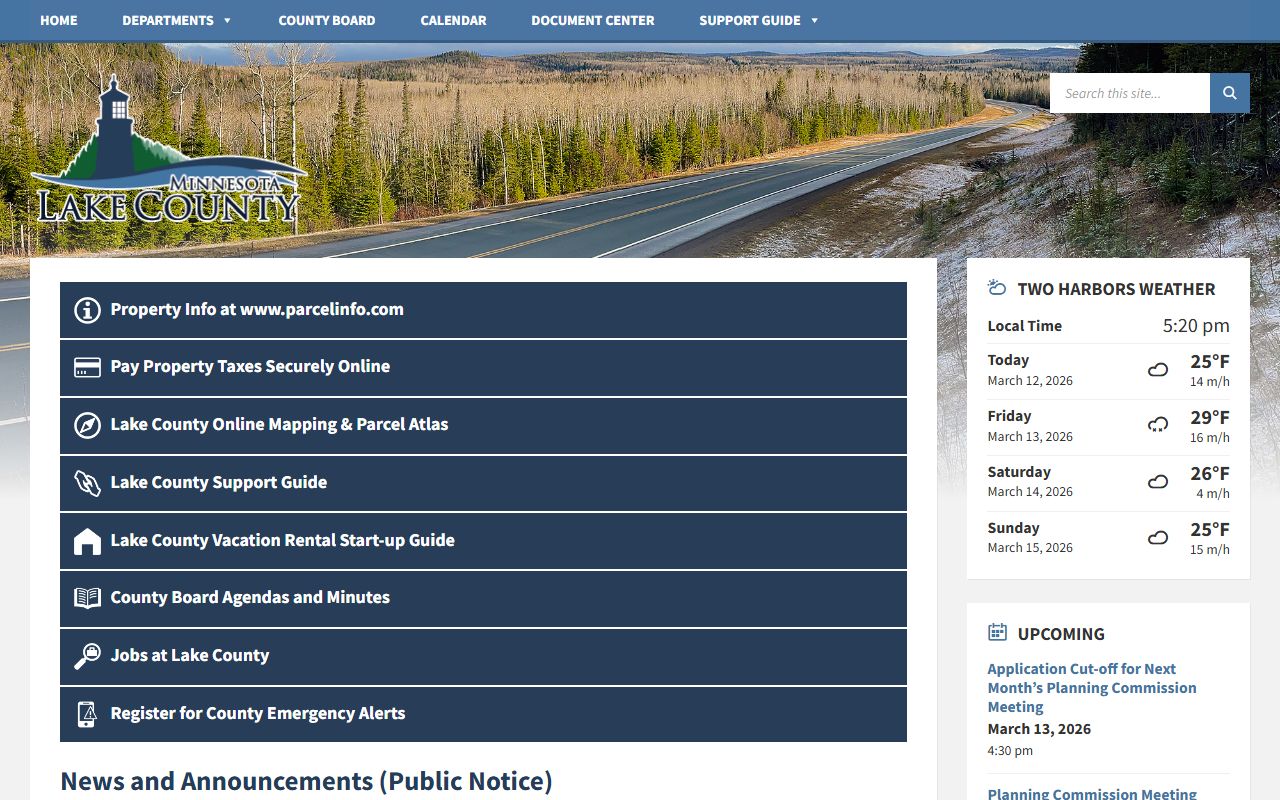
The county site lists recorder contact details and can help you confirm current hours before visiting or mailing a request.
How to Get a Death Certificate in Lake County
There are three ways to get a death certificate in Lake County: in person, by mail, or online. In person is the fastest.
To go in person, visit the Lake County Recorder's Office in Two Harbors. Bring a valid photo ID and be ready to pay. You will need the full name of the person who died, the date of death, and the county or city where the death occurred. For a certified copy, you must show you qualify under Minnesota law. Under Minnesota Statute 144.225, certified copies are available to the spouse, parent, child, sibling, grandparent, grandchild, or legal representative of the deceased. Attorneys on a legal case and government agencies with a legal need also qualify. Those outside these categories must explain a legal interest in the record.
To order by mail, download the MDH application form at health.state.mn.us/people/vitalrecords/docs/dcappia.pdf. Have the form notarized before mailing. Send the notarized form, a copy of your photo ID, and a check or money order payable to MDH to: Minnesota Department of Health, P.O. Box 64882, St. Paul, MN 55164-0882. MDH handles requests for Lake County deaths from 1908 forward.
Online orders go through VitalChek, the state's authorized online vendor. VitalChek adds a $7 service fee for standard delivery or $17.50 for rush processing. Online orders are mailed to you after MDH processes them, so they take longer than a walk-in visit. If you need the record quickly, the county office is the better choice.
Certified and Noncertified Death Records in Lake County
Minnesota issues two types of death record copies. Knowing which one you need before you apply will save time and effort.
A certified death certificate carries the official state seal and is accepted by courts, banks, insurance companies, and government offices. You need a certified copy to settle an estate, claim life insurance, or transfer property. Certified copies cost $13 for the first copy and $6 for each additional copy of the same record ordered at the same time. The state limits who can request certified copies under Minn. Stat. 144.225. Eligible parties include the spouse, parent, child, sibling, grandparent, grandchild, or legal representative of the deceased. If you do not fall into one of those categories, you will need to document a clear legal need for the record.
A noncertified copy does not carry the state seal. It shows the same information as the original death record but has no legal weight with courts or financial institutions. Noncertified copies cost $13 and are open to anyone. They work well for genealogy or building a personal file. Most family history researchers find noncertified copies more than adequate for their work.
The MDH eligibility page at health.state.mn.us/people/vitalrecords/tangible.html covers who qualifies for certified copies and what documents to include with your request.
Historical Death Records for Lake County
Deaths in Lake County before 1908 fall outside the state's registry. For that earlier period, you need to look at county sources or historical collections.
The Minnesota Historical Society (MNHS) holds a large collection of historical death records from across Minnesota. The Gale Family Library at MNHS is at 345 W Kellogg Blvd in St. Paul and is open Thursday through Saturday, 10:00 a.m. to 4:00 p.m. Call 651-259-3300 to reach research staff. The MNHS collection includes county death registers, church records, and cemetery data that predate the state system. Their death records guide at libguides.mnhs.org/vital/death explains what they hold and how to search it.
Lake County along the North Shore of Lake Superior was settled by iron ore and logging workers, many of Scandinavian descent. Church records from Lutheran and other congregations in the Two Harbors and Silver Bay areas can go back to the early settlement period and often contain burial and death information that is not found in civil records. The Lake County Historical Society may also hold materials that are not catalogued in state-level archives. Contact them directly if MNHS records come up short for an early Lake County death.
Online Death Record Access for Lake County
Several online tools let you search or order Lake County death records without traveling to Two Harbors.
MDH has an online verify tool that allows you to confirm whether a death record exists for a specific person. This tool covers deaths registered in Minnesota from 1997 to the present. It does not give you a full copy of the record, but it can confirm a date of death and basic identifying details. For more on what MDH offers online, visit health.state.mn.us/people/vitalrecords/services.html.
For full certified or noncertified copies ordered online, VitalChek is the state-authorized vendor. You set up an account, enter the details of the record, and pay by credit card. VitalChek mails the certificate to you once MDH processes the order. The extra service fee applies on top of the $13 base cost. Online ordering is convenient but slower than an in-person visit. Most requests take several business days to process and ship. If you need the record fast, visiting the Lake County Recorder's Office in Two Harbors is the better option.
Records older than 1997 are generally not available online. Those require a direct request to the county or to MDH by mail. Call MDH at 651-201-5970 or visit health.state.mn.us/people/vitalrecords/contact.html for help with older records.
Cities in Lake County
All death records for communities in Lake County are filed through the county recorder's office in Two Harbors.
No cities in Lake County meet the 100,000 population threshold for a dedicated city page. The county includes smaller communities such as Two Harbors, Silver Bay, Beaver Bay, Finland, and Knife River. Death records for all of these communities are handled at the county level through the recorder's office in Two Harbors.
Nearby Counties
These counties border Lake County. If you are not sure which county holds the death record you need, check where the death occurred.